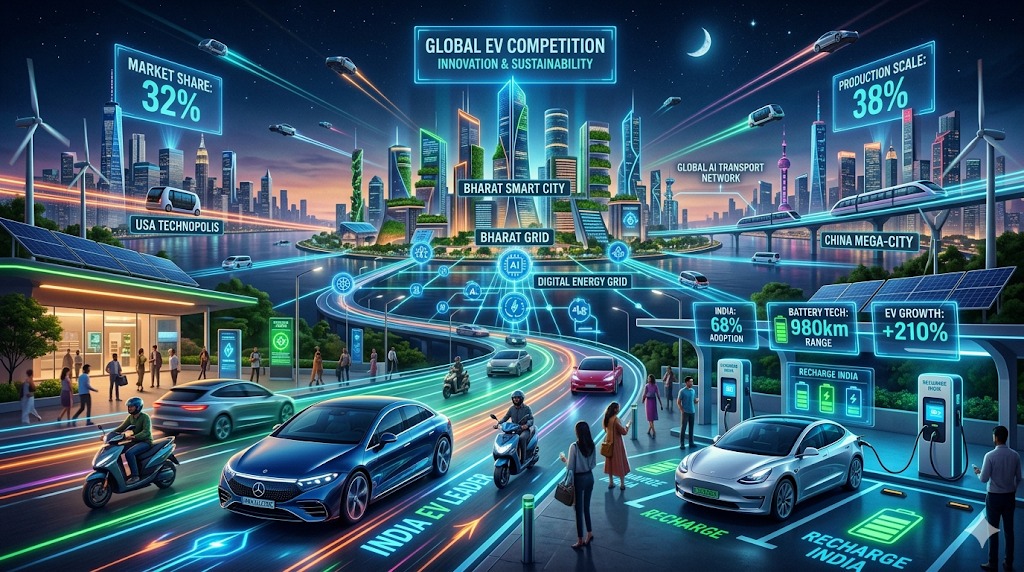
The global electric vehicle (EV) race was once dominated by American giant Tesla and Chinese powerhouse BYD. But in 2026, Indian EV manufacturers are emerging as serious competitors in the global electric mobility market.
Companies like Tata Motors, Mahindra & Mahindra, and Ola Electric are rapidly expanding production, improving battery technology, and building affordable electric vehicles designed for mass adoption.
India’s EV industry is no longer just catching up — it is beginning to challenge the dominance of the United States and China.
India’s EV Market Is Growing Rapidly
India has become one of the world’s fastest-growing electric vehicle markets. EV adoption surged significantly in FY2026, with strong growth across passenger cars, scooters, and commercial vehicles.
The Indian EV market is driven by several key factors:
- Rising fuel prices
- Government EV subsidies
- Expansion of charging infrastructure
- Lower battery costs
- Growing consumer awareness
Unlike the United States, where EVs are often positioned as premium vehicles, Indian manufacturers are focusing heavily on affordability and efficiency.
Tata Motors Is Leading India’s EV Revolution
Tata Motors currently dominates India’s electric passenger vehicle segment with strong sales growth and expanding EV market share. Popular models like the Nexon EV and Punch EV have become mainstream choices for Indian consumers.
Tata’s biggest advantage is its understanding of local market conditions:
- affordable pricing
- compact vehicle design
- high efficiency
- localized manufacturing
While Tesla focuses largely on premium EVs, Tata is building mass-market electric vehicles for everyday consumers.
This strategy mirrors how Japanese automakers once disrupted the American auto market through affordability and reliability.
Mahindra Is Becoming a Serious Global EV Player
Mahindra & Mahindra has rapidly increased its EV investments and SUV-focused electric lineup. The company’s EV growth has accelerated dramatically in 2026, helping it challenge both domestic and foreign rivals.
Mahindra’s strategy focuses on:
- electric SUVs
- advanced EV platforms
- battery localization
- software integration
Its Born Electric platform is designed to compete globally rather than only within India.
Industry analysts now view Mahindra as one of India’s strongest long-term EV contenders.
Ola Electric Is Challenging Traditional Automakers
Ola Electric is aggressively investing in battery manufacturing and EV production facilities. The company recently announced major investments to strengthen localization and battery cell manufacturing.
Ola’s business model resembles Chinese EV companies:
- vertical integration
- software-driven vehicles
- direct-to-consumer sales
- large-scale battery production
This approach helps reduce costs while improving scalability.
India’s Biggest Advantage: Cost Efficiency
China dominates EV manufacturing scale, while the United States leads in premium EV branding and software innovation.
India’s strength lies somewhere different:
affordable engineering at massive scale.
Indian companies are learning how to manufacture EVs at lower costs while maintaining acceptable performance and efficiency.
This matters globally because many developing countries cannot afford expensive Tesla-style EVs.
India could become the preferred supplier for:
- Southeast Asia
- Africa
- South America
- Middle Eastern markets
The China Challenge Is Still Massive
Despite India’s growth, Chinese EV makers remain extremely powerful.
BYD continues expanding globally with strong battery technology, large-scale production, and lower manufacturing costs. Chinese-origin brands are gaining market share even within India’s EV market.
Chinese EV companies currently lead in:
- battery supply chains
- charging technology
- manufacturing scale
- export capability
However, India is responding by diversifying battery sourcing and increasing local production to reduce dependence on China.
Tesla Faces a Different Kind of Competition in India
Tesla remains one of the world’s most recognized EV brands, but India presents unique challenges for premium foreign automakers.
High import tariffs and price-sensitive consumers make it difficult for Tesla to dominate the Indian market. Reuters recently reported that Tesla’s India sales remain relatively limited despite new launches.
Indian consumers often prioritize:
- affordability
- maintenance cost
- charging access
- efficiency
- resale value
This gives domestic EV brands a strong competitive advantage.
Government Policies Are Accelerating India’s EV Push
The Indian government’s “Make in India” strategy is helping local EV manufacturers expand rapidly through:
- EV incentives
- battery manufacturing support
- localization policies
- import restrictions
India has also maintained strict policies around Chinese investment in sensitive sectors, helping domestic manufacturers grow before facing full international competition.
The Future of India’s EV Industry
India may not overtake China immediately in EV scale or Tesla in global brand power, but it is creating a unique position in the global EV ecosystem.
The country’s EV manufacturers are proving they can compete through:
- lower production costs
- efficient engineering
- localization
- rapid innovation
- emerging market focus
As battery technology improves and charging infrastructure expands, Indian EV companies could become major global exporters over the next decade.
Final Thoughts
The global EV race is no longer just about the United States and China.
Indian EV manufacturers are rapidly transforming from domestic challengers into international competitors. Companies like Tata Motors, Mahindra, and Ola Electric are building vehicles designed for real-world affordability and mass adoption — two areas where global demand is growing fastest.
The next phase of the EV revolution may not be won only by the company with the most advanced technology.
It may be won by the company that makes electric mobility accessible to billions of people worldwide.