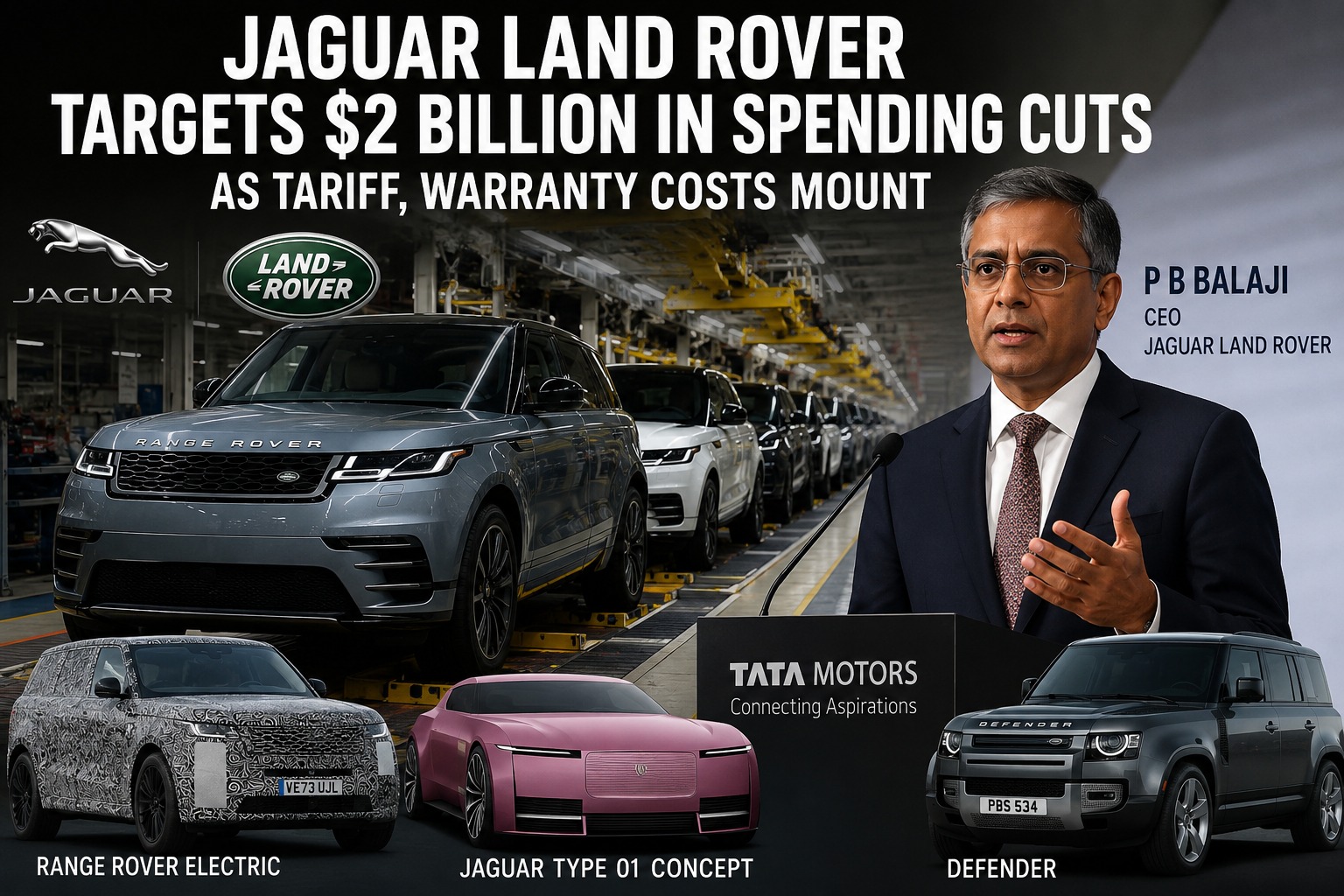
Jaguar Land Rover (JLR) is launching an aggressive cost-reduction program targeting more than $2 billion in savings over the next two years as mounting U.S. tariffs, rising warranty expenses, weaker Chinese demand, and cyberattack-related disruptions hammer profitability.
The British luxury automaker, owned by India’s Tata Motors, reported one of the sharpest financial deteriorations in its recent history. JLR’s pretax profit collapsed from £2.5 billion to just £14 million for the fiscal year ending March 2026 — a decline of more than 99 percent.
New JLR CEO P B Balaji said the company’s break-even point has risen significantly due to higher operating costs and external pressures. The automaker’s EBIT margin plunged to just 0.7 percent, leaving little room for further disruption.
Among the biggest challenges are U.S. tariffs introduced under President Donald Trump’s administration. JLR heavily depends on North America for high-margin Range Rover and Defender sales, and the tariff increases sharply raised import costs while weakening consumer demand.
Warranty costs have also surged as JLR continues dealing with quality-control issues and increasingly complex vehicle technology. Industry analysts note that luxury automakers face especially high warranty exposure because repair costs on premium SUVs and electrified systems can quickly escalate. Combined with inflation in raw materials and logistics, the pressure on margins has intensified dramatically.
Compounding the crisis was a major cyberattack that struck the company last September, forcing multiple factory shutdowns and disrupting operations for weeks. The attack severely impacted production volumes and supply chains during one of JLR’s most important sales periods.
Despite the financial turmoil, JLR says it will not abandon its long-term transformation strategy. The company still plans to invest approximately £18 billion over five years to electrify its lineup and reposition Jaguar as a fully electric ultra-luxury brand.
The first products from that strategy are expected later this year, including the production version of the all-electric Range Rover Electric and the debut of Jaguar’s radical new electric grand tourer, previewed by the controversial Type 01 concept.
JLR is also attempting to protect profitability by prioritizing higher-margin vehicles and streamlining operations across engineering, procurement, manufacturing, and software development. The company has not announced large-scale layoffs yet, but analysts expect tighter spending controls and possible restructuring across global operations.
Adding to the complexity is slowing luxury demand in China, previously one of JLR’s strongest growth markets. Chinese buyers are increasingly shifting toward domestic premium EV brands such as BYD, Nio, and Li Auto, intensifying competitive pressure on European luxury manufacturers.
Still, JLR sees opportunities in markets like India, where recent India-UK trade agreements have reduced import duties on select British luxury vehicles. Earlier this month, the company cut prices on imported Range Rover SV models in India by as much as ₹75 lakh following tariff reductions.
For JLR, the next two years may determine whether its expensive electric transition can succeed while navigating geopolitical instability, rising ownership costs, and a rapidly changing luxury automotive market.